Sunday, September 22, 2024

Coca-Cola Oreo Zero Sugar Limited Edition Soda Review

An Oreo and Coca-Cola crossover was not on my bingo card for 2024, but then again, has anything this year been? I appreciate the black and white design here, though considering the gimmicky origins of this amalgamation, why did I have to buy a box of this stuff? A single can would have been just enough, but alas, several bucks left my wallet for what is ultimately a commercial experiment in consumer tolerance.

But the design is quite sharp, if not busy, but that is obviously due to the very small real estate the seven and a half ounce packaging provides. Or at least, that is what my eyes first tell me: the more I let them wander, the less I enjoy it. The Oreo logo looks out-of-place with its usual blue and white coloring, and is far too small compared to Coke's. And then there is the perspective of the cookies themselves, which appear from the bottom, where as everything else is straight-on. Does that make any sense? Maybe not, sigh, I am not sure it matters.

The petite can cracks open like any other, but pours out slightly darker, with a bit of cacao in the air as you breath through your nose. Lifting up the tiny metal and taking that critical first sip, the brown concoction struggles to let the Coca-Cola shine through. This obnoxious overture instead goes all-in with dessert impulse, losing any sense of spice or citrus in favor of contrivances. My palate could not detect the presence of actual Oreo, but instead a most generic chocolate, complete with an aftertaste that continues to stain your palate of its sham cocoa persona far longer than it ever should. Ace-k, aspartame and sucralose are the trilogy of synthetic sugars on patrol today, but they clearly are not real carbohydrates, your tongue is smarter than that, and they simply cannot impersonate that unhealthy gratification one gets from traditional pop. Or an actual fondant-filled cookie. Completing the unpleasant performance is a slight creaminess, achieved obviously without dairy (this is sugar free, you know), but this milkiness lacks the honesty of actual moo juice, so mouthfuls die an early death, leaving behind a chemical stigma that no amount of subsequent sips could wash away.

But before we close, we first should take a small detour to the cookie themselves; yes, they also made a Coca-Cola based Oreo, complete with popping candies. The little pucks resemble the classic sandwich favorite, but sport a red half and an interior filling speckled with little crimson dots. The scent is unlike the caramel colored cocktail inspiration, sniffing indistinctly fruit, with notes of cherry, lime and pineapple. The calorie-ridden cookie crunches like you would expect, heavier on that famous cocoa of its biscuit origin than the the soda this whole crossover bothers with, though as you chew through the crumbly confection, lemon patiently creeps through to your tongue. A hit of cinnamon seals the deal as the two-layered wafer dissolves on your palate, but I ate what must have been half of my daily recommended intake of sugar and nary did any vanilla come out to play. I was initially disappointed until I ceased my chompers, when the fizzy sweetmeats added just enough lingering complexity that it satisfyingly spoofs actual effervescence. All the elements work overall but not individually, which is fine, I guess, since this is a limited time product.

Anyway, back to the potation, I mean, this ain't "The Kookie King." Neither the soda nor cookie are healthy, but hey, at least one of them is diet! (Try telling your doctor that.) We have twenty one grams of caffeine in the thin aluminum transport too, so good luck trying to replace your morning cup of coffee. Unless you drink like a half-dozen of these, and have dead taste buds.

company site

Sunday, April 23, 2023

Pepsi IHOP Maple Syrup Cola Review

What is the point here? Maple syrup flavored Pepsi? Who is the target audience, IHOP devotes and employees? In any event, the shrink-wrapped can feels cheap on the palm but at least exploits nature's sweetener well; I especially appreciate the sap dripping onto the brand's logo.

The smell of excessive sweetness billows out from the little opening atop the metal transport, but the first sip is awful. There is far too little carbonation, a glaring mistake that allows the gelatinous flavor of the pancake favorite to crash onto the palate and seize all control. There is absolutely no cola here, no vanilla, citrus or spice, just dumb sugariness to the point of numbing exhaustion. As a fan of grade-A dark amber maple syrup, you know, the real stuff, but this has less to do with nature then any soft drink ever has. I could go on, but I do not get paid by the word, and at this point, I have given this disaster more of my time than it deserves.

With 150 calories and forty one grams of sugar, this is not the product to make the argument that soda in any respect "good for you." Of course nobody says that, but whatever. On the whole, Pepsi IHOP Maple Syrup Cola is a novelty in the worst sense.

company site

Sunday, March 12, 2023

Pepsi Zero Sugar "New and Improved Taste" Soft Drink Review

Pepsi has nicked and tucked their "Max" cola more times than I can count without using my fingers and toes, and yet here we are again. The can claims we have a "new and improved taste," but says who? Visually, it is the same old black background with starkly contrasting text, but done is that aforesaid "Max" branding. That is not all that is gone, but wow I am getting ahead of myself.

The flavor is classic cola taste, heavy on the vanilla and spice, with a gentler citrus exposition. They make for a familiar if derivative time on the tongue, not terribly "good" but not an issue if you are hoping to polish off that twelve pack you bought. Aspartame and ace-k sweeten the pot, so to say, doing a decent job at tasting like sugar without really fooling you into believing we have actual carbohydrates involved. As I did not have a can of their previous version for comparison, nothing here disrupted my memory of what this is supposed to taste like, except for one area: carbonation. It is far less harsh than I can recall, my mouth still flooded with tiny little bubbles but instead punching your palate, they gingerly tap it. A fine but unnecessary remake.

But if there was one area where the brand fails me, it is with the ingredients. The original version(s) had an almost energy drink level of caffeine, with sixty nine milligrams per twelve ounces. Now? We have a pathetic thirty eight, which only dilutes the purpose of this product vs regular Diet Pepsi. What is the point here? A potent potable masquerading as a soda was niche yeah, or at least I assume so, but what reason does this have existing? Overall, Pepsi Zero Sugar "New and Improved Taste" is nothing new and arguably unimproved.

company site

Sunday, June 27, 2021

Pepsi x Peeps Review

What on earth are Peeps doing inside Pepsi? An Easter limited edition collaboration of course! These seven plus ounce cans promise "artificial marshmallow" flavor, but were only available to those lucky enough to win a social media contest. It is an awesome soft drink collectables, even if the label is shrink-wrapped on and only those with deep pockets or Instagram luck can encounter.

Well this is certainly Pepsi, that all-too familiar blend of spicy vanilla with just a touch of vague citrus. But then something happens, your tastebuds tricked into cozy memories of the cola classic only for the brown elixir to do a complete 180. No doubt the alleged marshmallow, the moment it crashes into the scene, things change. This is not your parents Vanilla Pepsi, oh no, and not for the better. Things are not quite right; a harsh alcoholic bite interrupts drinkability, fortunately foiled by the twenty six grams of added sugar. All from high fructose corn syrup, every imbibe is sugary beyond relief, as it commandeers your tongue and wrings out the possibility of nuance. This leaves each sip finishing with only carbohydrates to taste. That is not inherently an issue, but by the time you deplete the petite container, your palate is bewildered; where did the purported "Peeps" flavor go? This unsatisfying climax is a shame, but hey, who cares? It is not like most of the public is ever going to experience this.

This little thing has 100 calories and all the aforementioned ingredients, along with water, flavor, color, acids, and twenty four milligrams of caffeine. In the end, Pepsi x Peeps is a funky little experiment gone awry, but think of the stories I will be able to tell the grandchildren.

official site

Saturday, February 3, 2018

Crystal Pepsi Review

There are too many "throwbacks" this year, whether movies, video games, or food and beverage. Pepsi, no stranger of the "bizarre beverage" market, just dug its arm in its long list of past drinks and resurrected its ill-fated Crystal Pepsi. What is Crystal Pepsi? Well, it is clear cola. Remember TaB by Coke? They combated this competition extension and then the market went the way of the dodo bird. And for good reason.

Thousands of tiny bubbles illuminate your tongue, warming the crowd of taste buds for this familiar flavor. Its vanilla is muted in favor of citrus, a muddled cocktail of acidity with a heavy dosing of cinnamon and licorice- and that is about it. You know Pepsi? You remember the taste? Well, things are not much different here, despite its unique appearance. Sweetness is key here, not nearly as syrupy as sixty nine grams of high fructose corn syrup would have you believe. Things are brisk and unanticipatedly refreshing, revivifying on this hot and humid summer.

Each bottle contains cola ingredients, minus any coloring. 250 calories are here, along with sixty three milligrams of caffeine, which puts it right up on par with its competitors. However, the words "partially produced with genetic engineering" blaze the back of the label in small print but in all caps. With the criticism soda gets, I am sure it will not be long before we see a "Surgeon General's Warning" here. In the end, Crystal Pepsi is inexplicably hyped and disappointing if you jumped on that wagon.

official site

Sunday, April 23, 2017

Pepsi 1893 Citrus Cola Review

Extensions to Pespi's 1893 line include this "Citrus Cola" variety, who's dull orange can stripes the design from some of its sleekness. But it is an impressively clean can, regardless of all the text, who's most striking aspect is its regal text, escalating its look to a level the distracting color does not deserve.

The fragrant ebony elixir is fantastic to the nose, perking your interest and augmenting the excitement the novel notion of a "citrus" cola. The taste is full-blown cola, rich with vanilla and a myriad of spices, but the citrus is present, a beautiful bouquet of grapefruit and lime that highlights the breathtakingly satisfying experience. There is a roasted nutty nuances here, lurking deep in the obsidian broth. Sweetness is achieved via sugar, its grainy texture giving the raven solution a fascinating mouthfeel. It has real weight, an honest heft that perhaps is what differentiates this from the more commercial colas on the shelf.

Each can contains: water, sugar, color, flavor, preservatives, kola nut extract, not in that order. There is also 150 calories, but the flavor here is worth those, and more.

official site

Sunday, October 16, 2016

Pepsi 1893 Original Cola Review

The can of 1893, a sort of nostalgic launch from Pepsi based on the company's initial release. Its black can is svelte, a basic but sleek can with simply but striking text. But the design never explains enough to justify its rather pricey near two buck price tag, or at least to your average consumer.

Imbibes are heavy, coated in a thick but curt sweetness that has none of the syrupy attributes of most commercial colas. There is the flavor cinnamon and nutmeg, with a slight nuance of anise and licorice, a lovely blend of spicy nuttiness and familiar cola tastes. There is a slight bitterness to things, cut by the thirty nine grams of sugar, but giving each sip an earthy edge that balances out the saccharinity. The effervescence is coarse, with the can claiming it is "sparkling," and each sip confirms that claim. It is a fun experience, and quite a flavorful one, one that would certainly win if they company ever brought back the Pepsi Challenge.

Each can contains: water, sugar, coloring, acid, sodium citrate, flavor, preservative, caffeine, gum arabic, and kola nut extract, with 150 calories. Overall, Pepsi's 1893 Original Cola is a successful one, but never escapes being a niche beverage.

official site

Monday, August 15, 2016

Coca-Cola Life Review

Coca-Cola Life brings the fabulousness of true sugar with the grossness of Stevia, an all-natural diet sweetener more infamous for its bitterness than famous for its sugariness. But let us keep an unbiased mind and treat our eyes to the Pakistan green label, branded with uninteresting font chosen for elegance. Too many words are packed onto the tiny real-estate of the moss colored packaging.

A potent effervescence wakes up your palate, an unanticipated punch that is too sparkling for the drink's delicate insubstantialness. Life itself is considerably more intricate than this suggests, a tenuous body with insignificant innuendos of spices, only the dubious debuts of some canceled cinnamon and nullified nutmeg. The feisty carbonation demands more byzantine piquancy than the unsatisfying seltzer we sit sipping, instead left for dead with the deadened flavors of orange and vanilla. It is an unenthusiastic braiding, tastes holding hands but without motivation. With Coke using organic sweeteners, neither the citrus nor the vanilla are as complex as they should be. The bottle reads "natural flavors," but my tongue is not tasting them. All trepidation from Stevia's usual iniquity should be abated: every sip is painless and almost like its full-calorie cousin. It is not the obvious ersatz elixir expected when the argentate cap cracked open, but lacks the weight of a true sugared soda. It does not disappoint, but fails to ever wow.

Each bottle contains: water, forty grams of sugar, color, flavors, phosphoric acid, potassium benzoate, forty seven milligrams of caffeine, and Stevia. It hits almost a sweet spot between full and zero calories with its 160 per twenty ounces, but other than the natural sweetener its ingredient cocktail is pedestrian. As is everything else about.

official site

Monday, October 15, 2012

Pepsi Next Review

Pepsi Next was released earlier this year to little fanfare, debuting disappointing numbers and birthing flashbacks to Pepsi Edge and Coca-Cola C2. Its boring bottle could be to blame, at least partially, with only a white swoosh against a blue gradient. It is not cluttered like the company's myriad of Mtn Dews tend to be, but it can only confuse customers while chilling next to Pepsi, Diet Pepsi, Pepsi Max, Pepsi Throwback and Pepsi One; not to mention the dozen flavored aberrations of the aforementioned.

Fifteen grams of sugar for every twelve ounces, Pepsi Next tastes surprisingly similar to any other diet drink, with a bit more depth to its sweetness and more satisfying body. Vanilla and vague citruses play with impressively little medicinal influence and interruption, a soda spiced liberally with cloves and cinnamon, a bite that benefits both from a pinch of nutmeg and its potent phosphoric and citric acid acidity. But its Frankenstein's Monster syndrome of a sweetener system, with HFCS, aspartame, sucralose, and ace-K at work in any given sip, but the latter three of the tetralogy provides an unflattering artificial aftertaste comparable to any diet cola available. But while the black sap treads your palate, the sweetness is authentic and akin to your fatty's full calorie cola. Overall, Pepsi Next is an unflattering hybrid who tastes confused and will likely just confuse its audience.

Aside from the aforesaid hokey honeys, there is also: water, color, flavoring, acids, caffeine, and preservatives. Nothing special here, aside from its four-part saccharinity. On the whole, Pepsi Next is not bad for what it is, but it is just another two liters of water in an already flooded market.

official site

Saturday, March 31, 2012

Sam's Cola Zero Calorie Review

Probably different from their Diet Cola offering, Sam's Cola Zero Calorie is blatantly lifts its name and colour scheme from Coke Zero; more of a copy than an innocent homage. But it does not look all that bad, though it does scream generic, and this "Sam" does not own any other of their available sodas, making his identity a mystery to those bored enough.

Sam's Cola Zero Calorie is generally an insipid mocking of a rather pleasant if misunderstood drink. There is a sharp acidity that burns the mouth, giving each sip an impressive bite as it washes away what it follows. The taste unimpressive, though, denoting nothing that any self respecting cola should: diminutively spiced with pedestrian vanillin flavouring. There is only minor mention of any citruses, an apathetic amalgam that does little to stimulate either the experience or the drinker. There is thankfully an effective sweetness, obviously artificial but never overt, and the carbonation is equally efficacious, emboldening the aforementioned piquancy that is particularly potent as things die down. It is not a bad experience, however, and is adequate as a generic soda, and actually better than some name brands.

There is nothing in each two liter than has not ever been bottled before, with flavourings, acids, caffeine, fake sugars, and preservatives diluting the purity of the carbonated water. Overall, Sam's Cola Zero Calorie is a generic variety of Coke Zero, and it will suffice with those expectations.

Sunday, August 14, 2011

TaB Cola Review

There's no reason to discuss the history to the surprisingly still produced TaB cola, but with its ghost availability and general redundancy makes one really question the decision to keep this beverage available. Back in 1963, the colour pink certainly would stereotypically attract women, with the sexist thinking that this demographic would be the only to worry about wasting their waist, but presently it looks far too retro and barren to warrant even a passing glace outside one of curiosity. The background resembles the most basic of vintage wallpaper, or something of the such, and in all honesty it just doesn't look good. And the lack of any indication as to it being a cola is quite detrimental, as although it must have a fan base for it to be still brewed, it limits the growth of new consumers by avoiding clarification as to what genre of soda it belongs to.

Orange peel that's bitten by a sharp metallic tasting bitterness is what the first sip is described as. There's a stern of vanilla that's obstructed profoundly by the latter, however this alleviates one from really noticing its severe blandness and insipidity. There's a pleasantly present acidity and a surprisingly balanced sweetness, though it will never be mistaken for the real stuff. What is uncommon is that the experience doesn't taste as chemically hollowed as most, though the flavour is obviously fictitiously erected. Unfortunately though, the taste is all muffled prosaically together, and never does it become the least bit engaging, and it certainly grows more difficult to come closer to depleting the can in entirety. There aren't any moments when the profile depict any anticipated spices, such as cinnamon or nutmeg, though it is possible their presence is incapacitated. But by simply being more palatably delightful, TaB gets a recommendation over the drink that ultimately replaced it from Coca-Cola's prolific line up, but morosely it's wholly impossible for to once again be the little pink cola that could.

The sweetener that generated the slight aforementioned praise is of course saccharin, though it is bred with aspartame. Initially it used sodium cyclamate, but once banned the former was exploited, and it's use of the such is one of the few sodas that continue to do so, with the personal favourite braid of acesulfame potassium and sucralose becoming the desired synthetic sugars. In the end, TaB's obscurity, in both its scarce availability and public knowledge, censors the slight superiority it has over its popular younger brother Diet Coke.

official site

Sunday, July 24, 2011

Diet Bubba Cola Review

Diet Bubba Cola strangely comes in two colours and to my eye there was otherwise no difference between them, but because baby blue is assuredly prettier than boring white, I chose the bottle to the right. The name, however, is the first of what is sure to be many problems, as it honestly doesn't sound like something one wants to drink nor does it even feel appropriate to the flavour genre. The squiggly pattern and the spinning decal behind the logo are about the only visuals the label offers, and they don't really exist for any reason other than to keep the design from resembling the long gone no frill generic sodas from Jewels-Osco and such.

The flavour is initially basic but not necessarily bland, as it depicts soft notes of vanilla, spice, and citrus. The triptych of flavourings are congruently tasted but appear in the order stated, but unfortunately they're rather empty on the tongue. Cinnamon seems to be the lone seasoning, and this particularly gives the experience a cheap, if not puerile, feel. The citrus is of both orange and lime, but like the rest they're depthless and avoid presenting the drinker with examples that they understand their inspirations. There is a synthetic jejuneness that follows the troika coarsely, and it tastes hollow and further censors pleasure from the preceding flavours. Aspartame is the false sugar of choice, and it does its job adequately, however one can't ignore that if feels indirectly involved with the just aforementioned. The saccharinity reliefs thin shavings of artificiality, and the sweetness itself doesn't disembogue a firm robustness. It does, however, expectorate a slight mentioning of the familiar aftertaste that's widely and continuously tasted. Overall, Diet Bubba Cola's flavour would benefit grandly from an additional imitation sugar.

The bottle reads that there is six point eight grams of caffeine per standard serving, which seems to be oddly low, especially since it's such an exact number. Remaining ingredients include: water, colour, sweetener, acids, preservatives, and flavourings. Overall, Diet Bubba Cola doesn't give store brand sodas any better of a name than already have.

official site

Wednesday, June 29, 2011

Pepsi One Soda Review

Pepsi One's origins do at least make some sense, but it's now rendered completely pointless with the addition of Diet Pepsi Max. Normally though, one should criticize the latter and hail it as redundant, but since the company advertises the newborn far more than the former, it gives the impression that its predecessor is forgotten. And to strengthen my argument, it seems Pepsi One is so disremembered that it wasn't even given the latest redesign. The packaging it does sport is okay though nothing particularly special, with its surprisingly clean and almost formal look. The naming makes sense, at least initially, but they can legally claim that this is calorie free, as anything containing less than five can, so it actually ends up being more confusing than it should or than it's worth.

Neither Coke or Pepsi ever really excited me, but when ever there is a gun to my head and I am forced to pick between the two I always opt for the latter, and the same goes for their respected diet brethren. Pepsi One though, despite using my favourite sweetener paring of sucralose and ace-k, fails to honestly improve upon the general failure of either the sugared or the traditional aspartame containing beverage. The fault is found in the actual cola taste, which here is just as boring as one sadly expects, but it does at least taste better than Diet Coke, as if that's a compliment. Everything is ferally influenced by a chemical characteristic, as for instance while cinnamon is present, it isn't properly functioning in the sense that you only get the vague taste of the spice rather than the kick of the spice. Vanilla also makes an anticipated appearance, and though it doesn't exactly scream loudly with authenticity, it does advertises some appreciated though faint creaminess towards its stern. An orange peel flavour with an edge of lime is noticed and the rearmost certainly adds pleasant depth to the initial, but the two citruses were not designed with the typical sour or tartness and instead are involved solely for increased intricacy. Regrettably though, nothing tastes as pronounced it should, as the previously mentioned idiosyncrasy censors much of the believability and creditability of everything. The sugariness is false and glaringly so, but it doesn't taste as shallow as one may expect, and it doesn't yield an unpleasant aftertaste and your palate is actually fairly clean afterward, which is faint and sadly its only praise.

Fifty four milligrams of caffeine and the usual suspects can be found in each can, though this is one of the few diet sodas that does explicitly contain calories, albeit an obvious one. In the end, Pepsi One is a stupefyingly inessential extension of the line, though that isn't to say that the quality of the trademark product is much better.

official site

Wednesday, June 22, 2011

Polar Diet Double Fudge Soda Review

Polar produces many unusual flavours of soda at the fairly cheap price of generally a buck a bottle, however Diet Double Fudge just may be their most unique offering. It's unashamedly artificially flavoured, and the packaging sports an ice cream sundae of sorts dripping with the oft cloying sauce. But one must wonder what is "double" about it, as the former frozen dairy dessert is visually flavoured of vanilla, making the only appearance of fudge being what thickly coats it. It really makes you wonder, but perhaps this is digging too deep into something that doesn't demand such thinking.

The fudge flavour is richly of chocolate and sweetened appropriately but so that consuming an entire liter isn't ever overly saccharine. There's a distinct milkiness that's entirely complementing to the former, although this butteriness is vociferously separate from that of cream soda, as it acts here as an embellishment rather than a flavour focus. There is a synthetic characteristic that's organically seamed to the Western confectionery taste, and its noticeably is diminished partially by the creaminess and sugariness, but it undeniably renders the taste as very similar to the popular Tootsie Roll candy. And if this whole experience sounds too strange or just down right unpleasant, you're belief is understood but wholly incorrect, as it not only tastes good, but it challenges your palate to detect something that is so familiar yet is presented creatively.

There's no caffeine, and actually, there's nothing other than water, flavour, colouring, acid, and preservatives, and it's sodium free, for what ever it's worth. All in all, Polar Diet Double Fudge should be lauded for being so much more than your typical soda, even if it does have a few imperfections.

official site

Saturday, June 4, 2011

Diet Pepsi Vanilla vs. Coca-Cola Vanilla Zero

Both of the two prolific beverage companies almost always release their variety of the others' extension, whether it's an orange soda, caffeinated citrus energy soda, or flavoured cola. Some succeed and are remembered, but most are oft forgotten and replaced by some other similar tasting drink. And today we're going to compare the two big wigs vanilla based aberrations of their most known product.

Coca-Cola Vanilla Zero's can is wholly different from Diet Pepsi Vanilla's, almost as if they're trying to be opposite. One's white, the other is black, and the actual graphical characteristics conflict. Coke's cluttered design reminds me much of Moxie's modern insignia, which isn't exactly a compliment despite my enjoyment of the bitter Maine favourite. Pepsi's visual appearance takes a more modern approach then does Coke's, with sleek images of vanilla orchids and it's largely barren environment. The personally preferred can is obviously then of latter, even if neither can does much to excite me, and actually, the real kicker is the smoother name "Diet Pepsi Vanilla," opposed to the stumbling "Coca-Cola Vanilla Zero."

Diet Vanilla Coke, as it should be called, tastes of a poorly balanced vanilla injection into the classic cola flavour. There's no sense of creaminess as it battles across the tongue, only a harshly carbonated and improperly sweetened vanillin tinted fluid. It doesn't display any sort of depth, and instead of complementing the expected cola flavour it vapors over and chokes it from becoming actually detected. The Diet Pepsi Vanilla, on the other hand, goes for a cream soda inspired experience that's well crafted, especially compared to the former. The milkiness is thick and is initially just safe from being too rich, and the sweetness is defined and appropriately strong. The deeper flavour profile makes it far more pleasurable than it's counterpart, but both end up being quite a chore to fully finish, albeit for different reasons. Coke's chemical vanilla flavour is exceptionally unsavory, where as Pepsi's buttery mouth feel soon becomes too much. Overall, Pepsi clearly offers the better vanilla cola of the two, but you're better off choosing something else to drink.

official site

official site

Sunday, May 29, 2011

Diet Coke Review

Diet Coke's can seems as if it's trying to utilize simplicity to create sophistication, however it fails and instead looks boring and corporate. The stylistic writing of the word "diet" further confirms evidence towards my opinion, and the uninspired font used to print "Coke" clashes with any potential elegance displayed otherwise. Is the general design iconic? Well, you could make that argument, but just because it's a classic doesn't mean it's actually any good.

Upon tasting the first sip, the explicit explanation as to why Diet Coke's has never been a personal favourite is bluntly experienced. The initial mouth feel is bland, with no citrus notes singing, and there aren't any real spicings to note. What is noticed is a obtuse vanilla that's shallow and bland, and it doesn't create any sort of creamy lushness. That's not to insinuate that the general flavour profile demands to taste dairy based, but it rather feels as if it's chemically fabricated instead of being naturally present. What the formulation does do solidly, though, is the acidity, which is strong, pronounced, and just feels right. Unfortunately, it's really the only component to the genre, as a lethal combination of a dominating metallic taste and the aforementioned chemical quality, detriment the chance of one objectively enjoying the actual taste, instead of drinking it out of habit or necessity. Saccharinity never ended up becoming much of a focal point during my testing, which is a good thing, I guess, as it means that the infamous artificial aftertaste doesn't greatly influence. Overall, with Diet Coke outselling every soda outside the regular sugared Coca-Cola in the US, one can't help but be disappointed.

Some know me for my love of caffeine, which is something that Diet Coke actually contains a decent helping of; forty six mg. Other than that, there's colouring, acids, water, "flavourings," and a preservative. Overall, Diet Coke itself isn't recommended, but all of its fans are recommended to try something different next time they reach for a beverage.

official site

Saturday, May 21, 2011

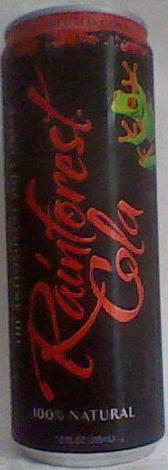
Rainforest Cola Review

Resembling the tourist favourite "the Rainforest Cafe," Rainforest Cola's sexy black background really allows the red text to seductively bounce into focus. The green frog should feel out of place, though it doesn't, as it prefers to complete the design rather than distract from it. Everything doesn't complement the package, however, and the main offender is the ascending sentence that buoys above the logo. The uninspired font clashes with the stylized nature of the nether, and it never really feels much like a selling point or point of distinction.

Rainforest Cola isn't for the mainstream diet Coke junkie. It lacks the famous bite commonly associated with the flavour genre, and it instead directs the attention to a braid of tamarind and acai. They both pleasure the others' company, and although the two are tasted distinctly from the other, they're together stitched into one of saccharine lace. As the flavour profile progress, it begins to mimic something of a coffee. It's entirely faint but remains wholly noticeable, and it dually complicates everything further as well as diverts the concentration. The prior has a certain creaminess to it that's tinted deeply of vanilla, however one does wish it was more cynosure. Citrus oils play a part in opening the experience for the former, an antipasto if you will. Lime is definitely detected and the transition into the initially discussed is seamless and preformed organically. During the movement, tangerine becomes an evident flavour, and it briefly rivals the lime for dominance before the main course dictates. It should be mentioned that the experience is sweetened by both real sugar and Stevia, and the combination isn't quite balanced. It feels dully sacchariferous and unsatisfying, but thankfully there isn't much in the way of the generally, though pitifully, accepted aftertaste. In the end, Rainforest Cola tries too hard to do too much, and it never really succeeds in any.

Well, doesn't this template look familiar? Anyway, there are thirty five calories and seven grams of sugar, which like previously stated, isn't enough. Green tea, and surprisingly the kola nut, appear, which is likely to of been involved in the creation of the confused flavour. Overall, Rainforest Cola's fifty cent cost at Job Lots doesn't quite excuse the cluttered execution.

official site